EN
EN
The Material That Rust Cannot Touch — and the Corrosion That Still Finds It
Aluminum does not rust. That sentence, repeated across product listings for aluminum roof tent models, is technically true and practically misleading. Aluminum corrodes differently than steel — no flaking red oxide, no structural perforation within a single wet season — but it corrodes nonetheless, and the mechanisms that drive aluminum corrosion in rooftop tent applications are less visible and more insidious than steel rust.
A rooftop tent shell parked in coastal fog for a week accumulates a film of salt-laden moisture that dries during the day and re-liquefies each night as humidity rises. This wet-dry cycling concentrates chlorides in surface micro-crevices. Within months, the telltale white powder of aluminum oxide appears along panel edges and fastener holes. The shell has not failed — aluminum oxide is structurally stable — but the cosmetic degradation signals the beginning of a process that, unchecked, pits the surface to a depth where structural thinning becomes measurable.
Pure aluminum reacts instantly with atmospheric oxygen to form a transparent aluminum oxide layer roughly 4 nanometers thick. This layer is self-healing — scratch it, and it reforms within seconds. That is the good news. The bad news is that chloride ions from salt spray, coastal fog, and de-icing road treatments penetrate this oxide layer and initiate pitting corrosion. A aluminum roof tent shell exposed to coastal conditions for three years without maintenance develops pits 0.1-0.3mm deep, concentrated at panel edges where water pools and evaporates cyclically.
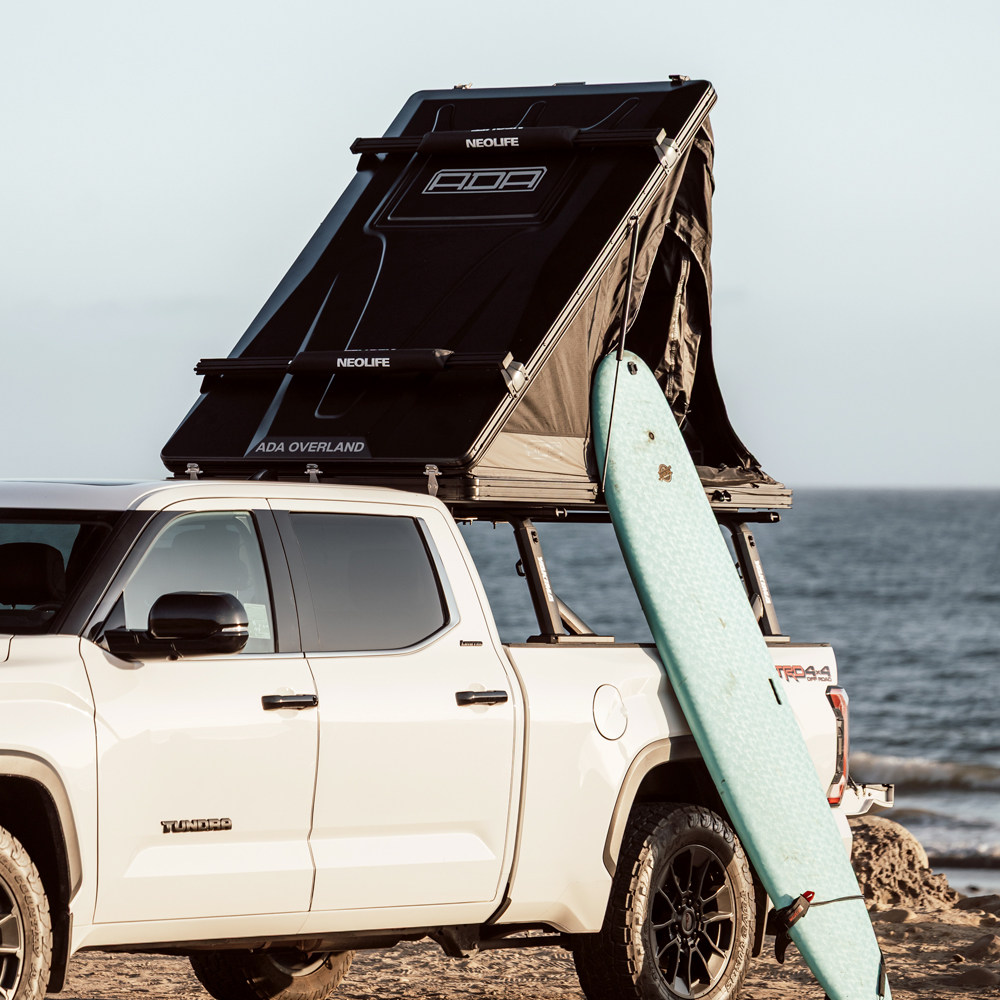
The practical implication: an aluminum shell 1.5mm thick loses roughly 7-20% of its cross-sectional thickness at pit locations after five years of coastal exposure. The shell remains structurally functional — a rooftop tent shell is not a pressure vessel — but the pitted surface becomes progressively harder to clean, and cosmetic degradation affects resale value and customer perception.
Die-cast aluminum — common on premium aluminum roof tent shells — contains silicon and copper alloying elements that improve casting flow and machinability. These same elements create micro-galvanic cells within the metal matrix. Copper-rich zones act as cathodes; surrounding aluminum acts as the anode and corrodes preferentially. The result is intergranular corrosion that follows the grain boundaries of the cast structure, creating a network of microscopic fissures that sheet aluminum, with its uniform rolled grain structure, does not develop.
Sheet aluminum (typically 5052 or 6061 alloy) corrodes more uniformly across its surface but at a slower overall rate because it lacks the internal galvanic couples that accelerate die-cast degradation. The trade-off: sheet aluminum cannot achieve the complex 3D shell shapes that die-casting produces, limiting design flexibility for aerodynamic hard shell profiles.
Anodizing thickens aluminum's natural oxide layer from 4 nanometers to 10-25 microns — a 2,500 to 6,000-fold increase. Type II anodizing (10-15 microns) provides adequate protection for inland use. Type III hard anodizing (25+ microns) is the correct specification for a aluminum roof tent deployed in coastal or high-humidity environments. The thicker oxide layer resists chloride penetration for roughly three times longer than Type II under identical salt-spray exposure.
The limitation: anodizing is a surface treatment, not a bulk material property. A scratch through the anodized layer to bare aluminum creates a localized anode that corrodes preferentially until the natural oxide layer reforms. On a tent shell subjected to tree-branch scratches and road-debris impacts, anodizing provides protection proportional to the percentage of surface area that remains intact and undamaged.
Powder-coated aluminum roof tent shells use a baked-on polyester or epoxy layer 60-80 microns thick. The coating provides a physical barrier rather than an electrochemical one — it works by preventing moisture and chlorides from reaching the aluminum surface. The failure mode is under-film corrosion: moisture penetrates a coating chip or scratch, spreads laterally beneath the intact coating, and lifts the coating from the aluminum substrate in expanding blisters.
The ASTM B117 salt-spray test provides a comparative metric. A powder-coated aluminum panel rated for 1,000 hours of salt-spray exposure without under-film corrosion at the scribe line outperforms a panel rated for 500 hours by roughly a factor of two in coastal service life. For procurement, request the specific ASTM B117 rating for the coating system used on the tent shell.
The stainless steel bolts mounting a aluminum roof tent to a steel roof rack create a galvanic cell in the presence of moisture. Aluminum is the anode (more active), steel is the cathode (less active), and the resulting current flow accelerates aluminum corrosion at the bolt-hole interface. The symptom is white aluminum oxide crust around mounting bolts, often mistaken for a leaking seal.
The prevention is simple: nylon insulating washers between the bolt head and the aluminum surface, and stainless steel bolts rather than zinc-plated steel. Stainless steel is closer to aluminum on the galvanic series than zinc-plated carbon steel, reducing the voltage potential that drives corrosion. Tef-Gel or similar anti-seize compounds applied to bolt threads provide additional galvanic isolation and prevent the thread galling that aluminum-to-stainless contact otherwise causes.
A rooftop tent distributor in Florida — where salt-laden Atlantic humidity combined with intense UV exposure creates one of the most aggressive corrosion environments in North America — tracked aluminum roof tent shell condition across 50 units over three years. Units with Type II anodizing (12 microns) showed visible pitting at panel edges by month 18. Units with Type III hard anodizing (28 microns) showed no visible pitting at month 36. Units with powder-coated shells showed under-film blistering at mounting-bolt holes on 40% of units by month 24, traced to insufficient edge coverage during the coating process.

The distributor revised its supplier specification to require Type III anodizing (minimum 25 microns) or powder coating with a documented ASTM B117 rating of 1,000+ hours. Within one season, warranty claims related to shell corrosion dropped from 12% of units sold to under 3%.
Request the Anodizing Specification. A supplier listing "anodized aluminum" without specifying Type II or Type III and the coating thickness in microns has not controlled the process. A aluminum roof tent destined for coastal or tropical markets needs Type III anodizing at 25+ microns with a documented test certificate.
Inspect Coating Coverage at Edges and Holes. On a production sample, examine powder-coating coverage at panel edges and bolt holes under 10x magnification. Bare aluminum visible at edges indicates insufficient coating wrap that will initiate under-film corrosion within the first season of coastal exposure.
Verify Fastener Isolation. Confirm that the aluminum roof tent hardware kit includes nylon washers for all aluminum-to-steel bolt interfaces. Stainless steel bolts should be specified, not zinc-plated steel. If the kit lacks these items, budget $15-30 per tent for aftermarket isolation hardware — a trivial cost compared to the shell degradation it prevents.
An aluminum roof tent does not rust (iron oxide), but aluminum corrodes through pitting and white oxide formation when exposed to salt, coastal fog, or road de-icing chemicals. The corrosion is cosmetic rather than structural in the short term but progressively degrades surface quality and resale value.
Type II anodizing (10-15 microns) on an aluminum roof tent shows visible pitting within 18-24 months of coastal exposure. Type III hard anodizing (25+ microns) maintains corrosion resistance for 5+ years under the same conditions. Inland use doubles these timelines approximately.
Powder coating on an aluminum roof tent provides a physical moisture barrier rather than an electrochemical one. It works effectively as long as the coating remains intact. Chips and scratches expose bare aluminum and initiate under-film corrosion that spreads beneath the intact coating.
White powder around aluminum roof tent mounting bolts indicates galvanic corrosion between the aluminum shell and steel bolts. Install nylon insulating washers between dissimilar metals and use stainless steel bolts instead of zinc-plated steel to minimize the galvanic voltage.
Sheet aluminum (5052/6061) corrodes more slowly and uniformly than die-cast aluminum in an aluminum roof tent application because it lacks the internal micro-galvanic cells created by silicon and copper alloying elements in cast aluminum. Die-cast offers superior shape complexity at the cost of higher corrosion susceptibility.
Rinse the aluminum roof tent shell with fresh water after every coastal trip to remove salt deposits. Apply a pH-neutral aluminum cleaner annually to remove oxide buildup from crevices. Inspect and replace nylon isolation washers at mounting points every two years. Touch up powder-coating chips with a two-part epoxy paint within 30 days of damage.
 Hot News
2026-07-25
2026-07-17
2026-07-14
2026-07-11
2026-07-09
2026-07-02

Zhejiang Ada Outdoor Products Co.,Ltd. provides premium rooftop tents and outdoor camping gear for global B2B partners. 8+ years, 60+ patents, strict QC. Trusted by international brands. Request OEM quote today.